Context
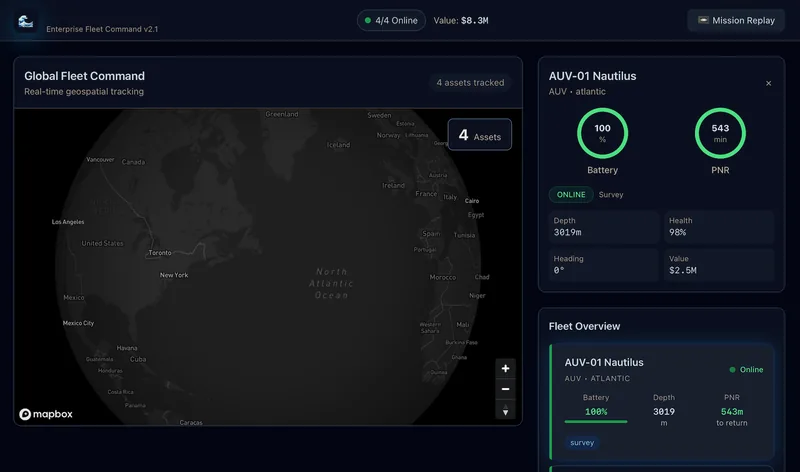
Abyssal Twin is an open-source digital-twin platform for fleet telemetry: high-frequency sensor streams, anomaly detection, and mission replay. The interesting engineering problem is not the dashboard. It is keeping a live model of a physical system correct when the network is unreliable, the stream is bursty, and the operator needs to reconstruct exactly what happened after the fact.
Constraint
The system had to run across edge and cloud, stay useful when connectivity dropped, and remain inspectable after an incident. That rules out a demo that only works on a clean, always-on connection.
What the method would test
A paid Production Readiness Diagnostic would score the system across five axes. For this self-assessment, the honest statement is narrower: the repository demonstrates the architecture, not a production fleet’s reliability record.
| Axis | What is visible today | What is not yet proven |
|---|---|---|
| Reliability & Eval Coverage | Real-time edge/cloud split; replay path | Multi-region failover under sustained load |
| Cost-per-Success & Routing | 52% token-spend reduction in benchmark | Cost per active vehicle at fleet scale |
| Guardrails & Adversarial Safety | Deterministic replay; bounded inference | Adversarial sensor input and abuse cases |
| Observability & Drift | Traceable stream and replay | SLOs, alert fatigue, on-call runbooks |
| Regulatory Control Readiness | Open-source, inspectable code | Data retention and operator controls in a real deployment |
Evidence
- Reproducible: the repository is public; the benchmark can be re-run.
- Architecture is the claim: edge inference, a cloud reconciliation path, and full-fidelity replay.
- The gap is operational: a benchmark is not a production reliability record. A real assessment needs traffic, incidents, and an owner.
Lesson
The hardest part of a digital twin is not rendering the model. It is proving that the model and the physical system stayed in agreement when the network did not. That is an observability and governance problem before it is a UI problem.
What this means for a peer
If your team has a working demo and no incident history, you are not ready to claim production readiness. You are ready for a diagnostic that tells you which two gaps would hurt first.